Vertical Pressure Filter Cloth
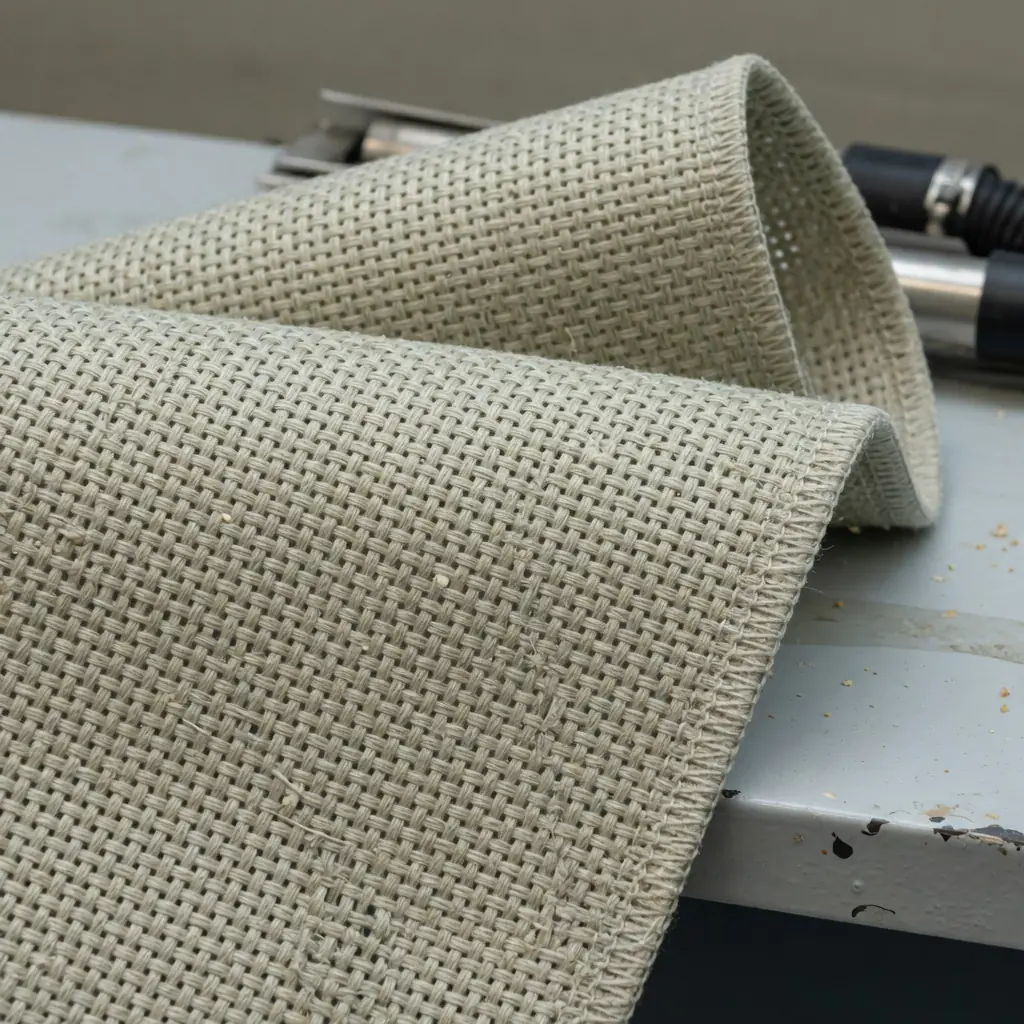
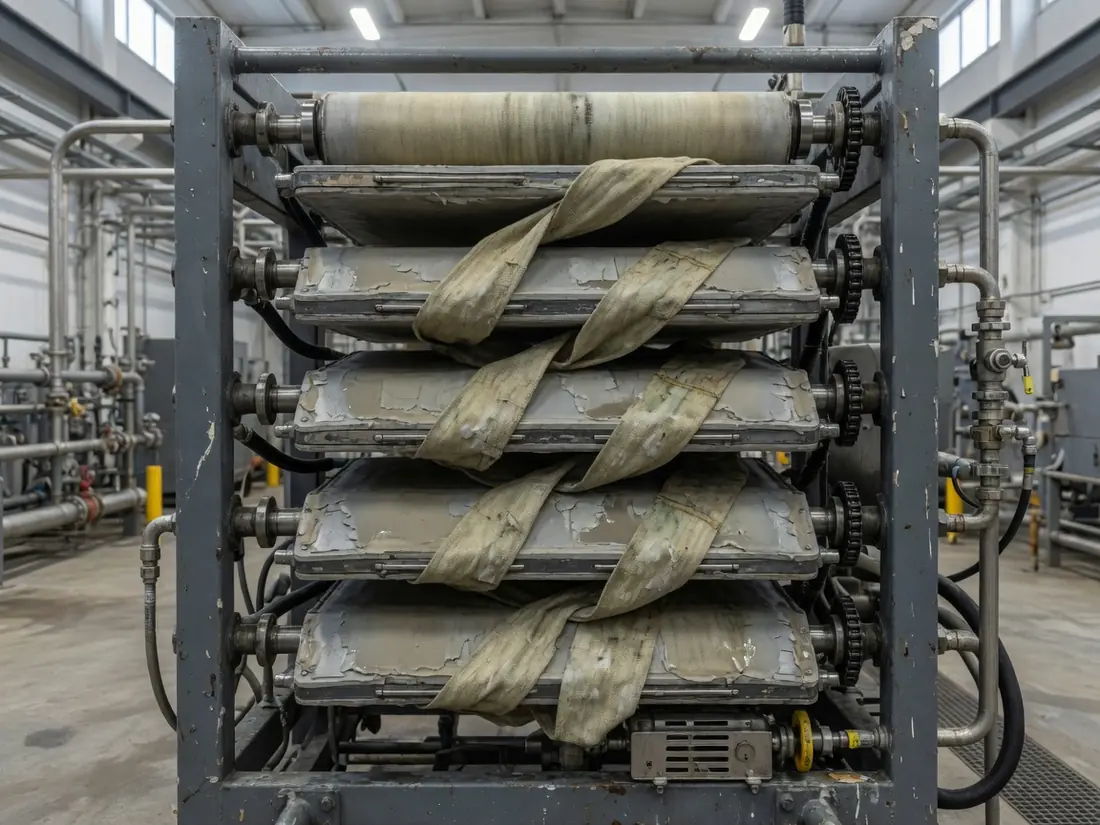
Vertical pressure filter cloth is a replacement filter cloth, supplied as an endless zigzag belt with low elongation, for vertical pressure (tower press) filters such as Metso Larox PF type machines.
Machines and industries
Machines
"Tower press" is the same machine under another name — there is no separate cloth page for it.
Industries
Per-slurry engineering pages for this family publish in later batches. Lithium is split by process route — salt-end and mine-end are different duties and we do not sell one cloth for "lithium". Until those pages are live, send us the slurry directly.
Not sure which cloth? Tell us your slurry →
Weave, polymer and elongation
Cloth polymer is chosen from your slurry chemistry — pH, temperature and particle size — not from a one-size catalog. On a vertical pressure filter the construction also has to hold its length: the cloth indexes through the stack as an endless zigzag belt, so low elongation under working load is part of the specification, not an optional extra.
We do not publish cake-release, life or throughput figures for a weave. Those depend on the construction finally specified for your duty, and we would rather state that than print a number you cannot hold us to.
- PET monofilament
- PET monofilament + multifilament
- PP (polypropylene)
- DLW / MLW multi-layer weaves
- Special alkali- and hydrolysis-resistant grades
This is the industry-level range. Our own mill's confirmed weavable polymer list for this family is being confirmed in writing and is not published yet.
Parameters
Every parameter that ends up on your confirmation
Five columns: what the parameter governs, where the industry reference comes from, how it gets fixed for your order, and what we need from you to fix it. The source tag on each row says whether the reference is imposed by the machine, is a property of the polymer itself, or is a published test method — none of the three is a statement about our own mill. The full materials reference →
Cloth construction
| Parameter | What it governs | Industry reference | How it is set for your order | What we need from you |
|---|---|---|---|---|
| Polymer Polymer property | The chemical and thermal envelope. Everything else is chosen inside whatever the polymer allows. | PP / PET / PA / PPS / PVDF / PTFE / PE — see the polymer table for the envelope of each. | Chosen from your slurry chemistry and temperature. | Slurry name, pH, temperature, and any cleaning chemistry. |
| Yarn form Polymer property | Cake release, wash-back behaviour and how readily the cloth blinds. | Monofilament / multifilament / mono+multi / staple. | Chosen from particle size distribution and whether release or clarity dominates. | PSD or a d50, and which of the two is hurting you today. |
| Weave Polymer property | The balance between filtrate clarity, permeability and resistance to blinding. | Plain / twill / satin / double layer. | Chosen with the yarn form as one decision, not two. | Same inputs as yarn form. |
Filtration behaviour
| Parameter | What it governs | Industry reference | How it is set for your order | What we need from you |
|---|---|---|---|---|
| Pore size / retention rating µm Test method | The particle size the cloth is aimed at holding. | For a woven cloth this is a nominal rating, not an absolute cut-off — woven media do not have a single pore size, and the cake quickly becomes the real filter. | Targeted from PSD and required filtrate clarity. | PSD, and your filtrate spec if you have one. |
| Cake release behaviour Set per order | Discharge, carry-over, and whether cake releases cleanly without blinding. | Driven by surface finish and yarn form more than by rating. | Tuned through weave, calendering and surface treatment. | Photographs of the discharge point and a description of the carry-over. |
Dimensions
| Parameter | What it governs | Industry reference | How it is set for your order | What we need from you |
|---|---|---|---|---|
| Filtration area (pressure filters) m² Set by the machine | The equivalent of width×length for a tower or chamber machine. | Set by plate size and plate count. | Confirmed per enquiry. | Plate size and number of chambers, or the machine model. |
Operating envelope
| Parameter | What it governs | Industry reference | How it is set for your order | What we need from you |
|---|---|---|---|---|
| pH range pH Polymer property | Chemical attack, and for PET specifically the hydrolysis risk. | PP and PTFE span effectively the whole scale; PET is limited on the alkaline side, PA on the acid side. | Polymer chosen against your measured pH, including during cleaning. | Operating pH and cleaning pH — they are often different and the cleaning one is often the killer. |
Machine interface
| Parameter | What it governs | Industry reference | How it is set for your order | What we need from you |
|---|---|---|---|---|
| Machine family Set by the machine | Everything. The cloth form for one family does not fit another. | Rubber-belt HVBF / vertical tower press / indexing or tray vacuum / drum, disc, leaf, chamber press. | Confirmed before anything else is discussed. | Machine brand and model, or a nameplate photograph. |
| Cloth form Set by the machine | How the cloth is made up — endless belt, zigzag loop, cut panels. | Endless belt for rubber-belt HVBF; endless low-elongation zigzag for tower presses; panels for chamber presses. | Follows the machine family. | Nothing beyond the machine. |
| Elongation under tension % Polymer property | Whether the cloth loop stays within the machine take-up range in service. | Low-elongation construction is a defining requirement on tower presses. Heat setting is what holds it. | Controlled through construction and heat setting. | Take-up range of the machine, if known. |
Confirm parameters for your machine →
Filter Cloth Specification Guide
The guide is written for vertical pressure filters as well as the belt machines, and its seam and edge sections cover the constructions an endless cloth for this machine type is built with.
Fifteen pages on how a filter cloth specification is built and read: the polymer envelope, yarn form, weave and finish, the four seam constructions drawn out, edge treatments, how to read an air permeability figure, and the full parameter set. It is the methodology edition: every value in it is industry reference — published polymer properties, limits the machines impose, and public test methods. None of it is our mill's own confirmed data, and a parameter edition carrying our values follows when the mill confirms them in writing.
Endless zigzag construction
A vertical pressure filter cloth runs as a continuous zigzag loop through the plate stack, so the joint has to survive indexing as well as pressing, and it must not stretch the loop out of registration. The joint and edge construction is matched to the cloth you are replacing.
The exact joint and edge constructions our mill runs for this family are being confirmed in writing and are not listed here yet. We would rather send you a short answer after the RFQ than publish a construction list we cannot stand behind.
The four filter cloth seam types
Clipper: rows of metal hooks on each cloth end interleave, and a pintle wire passes through the channel they form. PAD or welded: the two cloth ends are skived and overlapped, then thermally fused into one thickness. Spiral: a helical coil is fixed to each cloth end, the two coils mesh, and a pintle wire passes through. Sewn overlap: the two cloth ends overlap and are joined by rows of stitching.
Fastest way to get this right
- Photograph the joint area along the full width
- Photograph both edges where they run against the plate
- Keep the old cloth until the replacement is fitted
The measuring guide shows what to photograph and how to measure a plate-stack cloth.
What is made to order, and what we need from you
Set by your machine
- Plate size and filtration area
- Zigzag loop length set from the machine, not from a catalogue size
- Joint construction matched to the cloth you are replacing
- Edge treatment specified with the joint
Upper limits on area and loop length are confirmed per RFQ. We would rather confirm your dimension than advertise a range we have not put in writing.
What we need from you
- Plate size or filtration area
- The old cloth — or clear photos of it
- Machine brand and model — or "unknown"
- Slurry name and what failed
We quote per RFQ. No online checkout.
How this cloth is produced and checked
- 01Materials
- 02Weaving
- 03Heat Setting
- 04Calendering
- 05Cutting
- 06Joint / Seam
- 07Edge Treatment
- 08QC — Air Permeability Testing
- 09QC — Tensile Testing
- 10Inspection
- 11Packing
- 12Export
Air permeability and tensile testing are part of the QC step. The specific test method names, and which steps run in our own mill for each cloth family, are being confirmed in writing and will be published once they are — we do not print a standard number we have not verified. Certificates are supplied as documents on request; we do not run a logo wall.
Asked before a quote
What information do you need to quote a replacement tower press cloth?
Plate size or filtration area, the machine brand and model (or "unknown"), the old cloth itself or clear photos of it, the slurry name, and what failed. Optional but useful: pH, temperature and particle size distribution.
These are the questions a quotation cannot start without. The list will grow as real enquiries come in — it is not padded out in the meantime.
Get a quote for your machine
Send the plate size or filtration area, the machine brand and model, photos of the old cloth, the slurry name, and what failed.
Not sure about dimensions? Measure your old cloth first.
Sample availability, size, freight and lead time are confirmed per request.